Sunday, February 1, 2015

The Results (Part 1) - What attitudes enable successful inclusive arts practice at Epic Arts?

Over the last 12 months I have being trying to find out what inclusive arts means, in reality and in action, to the people at Epic Arts in Cambodia. Through interviews and observations with staff, students and participants at Epic Arts, I have being trying to answer this question:

“What are the perceptions, experiences and practices of activity participants, facilitators and programme managers at Epic Arts Cambodia?”

To try to answer this question, I conducted interviews and observations and from these I found 3 key areas that people identified as seen to be needed to make successful inclusive arts happen at Epic Arts. These are:

‘Attitudes’ – How people need to think and feel.


‘Actions’ – What people need to actively do.


‘Personal Skills’ – What skills people need to cultivate.


These attitudes, actions and personal skills are the foundation of the work that happens at Epic Arts and are I hope these elements can assist in a deeper understanding of Epic Arts and the essence of its inclusive arts practice and become a guideline for what is needed for successful inclusive arts practice in other organisations.

In this blog post I will discuss this question;

“What attitudes enable successful inclusive arts practice at Epic Arts?”

The people I interviewed at Epic Arts, both staff and students, were asked this question and there were a number of clear areas that emerged from their answers.

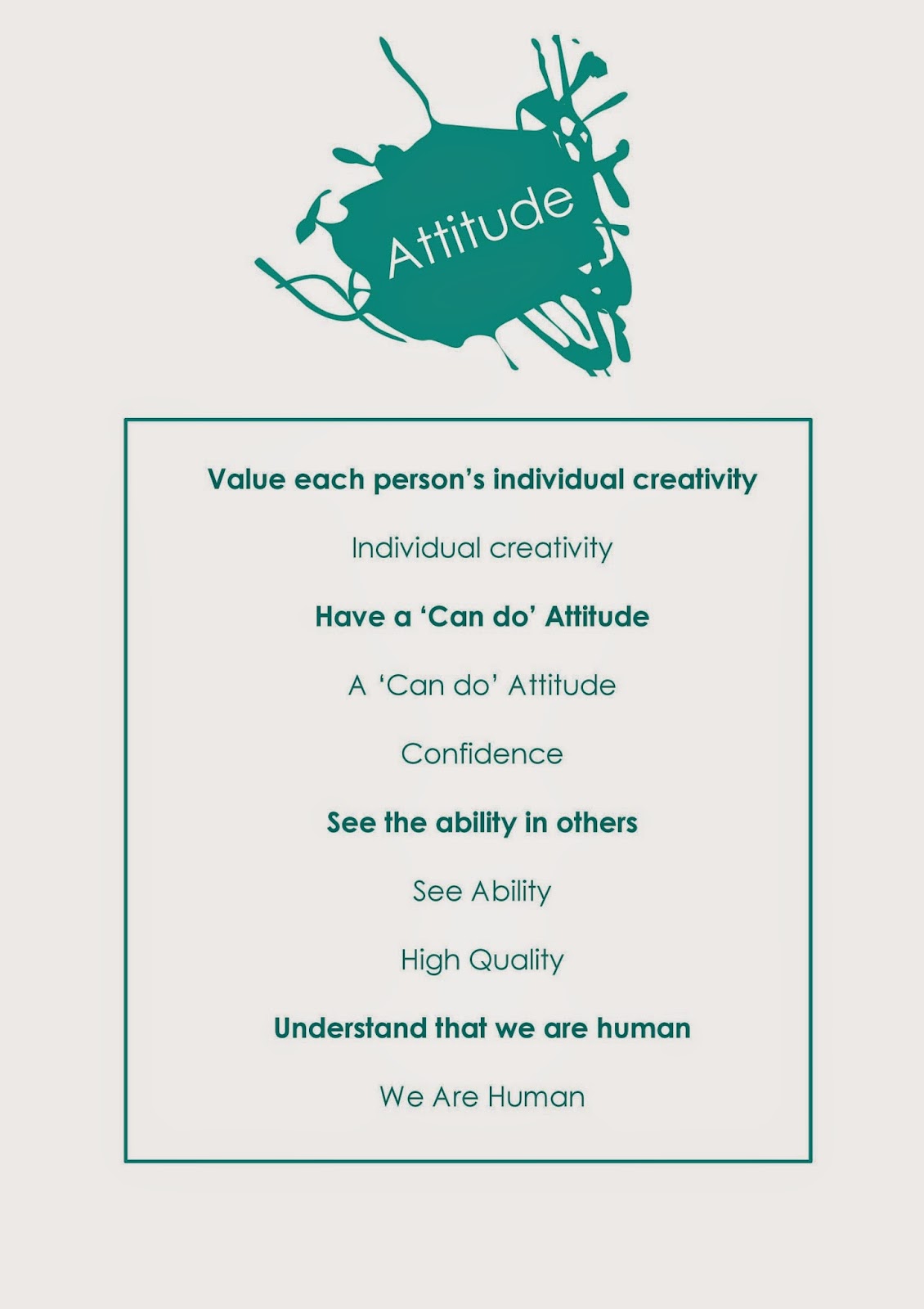
These are the ATTITUDES that are seen to be required for successful inclusive arts practice at Epic Arts:

  •  Value each person’s individual creativity
  • Have a ‘Can do’ Attitude
  •  See the ability in others
  • Understand that we are human


The first attitude that was seen to be important for enabling successful inclusive arts practice was to ‘Value Each Persons Creativity’. People felt that it was important to value each persons individual creativity in all areas by focusing on the need to see each person as unique and that they have an exclusive way of being creative. This unique and individual expression is to be valued and celebrated for its idiosyncrasy.

One staff member said –

“I think inclusive arts promotes the value and creativity of every  single person.

A performer reinforced this message by saying –

“We make sure that we can include everyone’s creative ideas as each person has something creative in their mind in dance, in drama and in art.”

By accepting someone’s manner of displaying their creativity and creative ideas, a person is given value and this seems to be at the heart of delivery, management and learning at Epic Arts.

An inclusive arts student said –

“Different bodies move differently and different minds think differently and this makes new, unique things from each persons inside creativity”

By seeing a persons individual creativity and valuing it for being a creative expression of a different body and mind, the person is seen as unique and can contribute something ‘sui generis’ to a creative process that no one else could. The person then becomes exclusive in their input, output and purpose.

The special education project consultant said

“We are all creative people and the inclusive arts work at Epic Arts enables everyone to express their creative ideas and to have these ideas accepted.”

I think the idea that the consultant sees all people as creative is significant to the success of practice and empowerment at Epic Arts. She points out that inclusive working in the arts enables everyone to express their creative ideas…. they are enabled, they are already creative; but need to be empowered and permitted to express their inner creative dialogue.

A performer expressed this very simply;

“It is important to see each person as a unique, creative, human being if we want to be successful in being inclusive artists and practitioners.”

Without this focus on individual creativity, the inclusive arts practices would not be successful as this cartoon points out. 


By asking the animals to achieve a task in exactly the same way, it isolates every other animal other than the animal that has the ability to achieve within the set boundaries presented. Each person ‘creates’ in a different way and this needs to be accepted and celebrated. Within inclusive arts there needs to be a wide understanding of enabling people to achieve the expression of their inner creativity in what ever way they do this and not by being compared to others.


As this quotes above says, “Everyone is a genius! But if you judge a fish by its ability to climb a tree, it will live its whole life believing it is stupid”. What I have seen at Epic Arts is that people dont have to fit in to boxes of ability and inability, but that they have their own way of being creative that does not need a label or a need to understand and define that can confine - all are appreciated for what they do and for the individual way that this is executed.

The Inclusive Arts Course at Epic Arts reflects this idea of individual creativity as one volunteer says.

“Students aren’t assessed on a scale of ‘bad to good, or ‘poor to excellent’ but on a scale of their personal best and personal ability.”

One persons ‘poor’ is different to another persons, just as one persons ‘excellent’ is different to another persons An individual’s ability and creative development should be valued and seen as achievement within their unique expression, definitions and ability.


Have a ‘Can do’ Attitude

The second attitude highlighted was a  ‘Can do Attitude’. This attitude is about ‘giving it a go’, having a try and doing something even when other people don't believe you can.

One staff member said that,

“When people tell me I can not do something because I am in a wheelchair, it makes me want to try something more and work out a way of doing it.”

Staff and students at Epic Arts shared that often they find themselves battling attitudes of what they can and cant do in society within the country and sadly these attitudes are often experienced first in their own families and communities. People with disabilities are told they cant leave their homes, travel, get married or have a job and for women there is an additional oppression as they must fight for the right to independence and the opportunity to make their own decisions and have a voice that is heard.

Many Epic Arts staff and students have to actively show this ‘can do’ attitude in everything they do, to combat attitudes they experience daily in their communities and in their families.

One staff member said:

“We try to show people what we can do so that people can learn and understand about the abilities of all people, whether this is performing or making a piece of art or attending a meeting, we need to get out there and show people what is possible”

One staff member I interviewed at Epic Arts provided an example of this ‘can do’ attitude in action.

Sok has been told all his life he cannot do things, but he has proved everyone wrong. He lost his arms when he picked up a landmine when he was 7 years old and his family and surrounding community felt that Sok’s life would be forever restricted by his disability and almost not worth living. But Sok’s ‘Can Do Attitude’ shined through. He was told he could never ride a bicycle so he learnt to do it in the dark so no one would be able to see him practice; now he has his own motorbike. He was then told he couldt be a teacher because of his disability (and is still banned from doing so by the government) but he has now opened his own school with over 70 students. By trying and striving and believing, he was able to defy the confining attitudes of others and develop to succeed.

One of the non-disabled students on the Inclusive Arts Course at Epic Arts shared a conversation with a man in the village when he and his friends were explaining about what they did on the course –

“The man said, “But how can he dance, he is in a wheelchair. You must help him because you are not in a chair”. I said “No, I dance with him, he doesn’t need my help, he can do it himself!.”

All the students aim to have an ‘I’ can do it attitude and a ‘they’ can do it attitude.

One of the performers at Epic Arts also said that,

People told me I would not be able to get a job because I have a disability. I believed that I could….now I have a good job, I am an artist and I travel around the world”

For many people with disabilities in Cambodia its other peoples attitudes that cause the problems. People with and without disabilities have to push against these perspectives and prove that all people ‘can do’, but to do this a ‘Can Do Attitude’ needs to be developed and cultivated by leaders.

One of the consultants at Epic Arts said,

“I think it's important for my team to have the attitude that they will give it a try, as the students experience is so important and if we can make something happen for them with a little bit of rethinking then we should.
It’s just about thinking we can do it!”

These are images are of activities at Epic Arts such as paddle boarding and a boat trip and show this idea of implementing the ‘Can Do Attitude’ for the benefit of the participants at Epic Arts. 


As the consultant says above, the students experience is paramount and instead of saying it can’t be done, it’s just a case of having the confidence to give it a try and work out how it can be made possible.


See the ability in others

The third attitude that was highlighted in the interviews was to ‘see the ability in others’. The people I interviewed often talked about when people hadn't seen the ability they had and had made assumptions about what they could and could not do.

One staff member said:

“It is very important to not decide what a person can do before they try to do it themselves. If we tell people they will not be able to do something, they might believe it and never try it.”

By making the decision for a person about what they can and can’t do, they may never discover their own ability as they have that opportunity to explore removed by another person’s attitude.

One of the managers at Epic Arts, Buntheng points out that the,

“Development of people can only happen when the ability is seen in all people and time is take to encourage their ability.
Believing in what other people can do is the first step to them developing and growing, if we dont see the possibilities for someone we can stop their potential in its tracks, you have to first see the possibilities and then work to make it happen.”

Seeing the ability in someone is not about putting pressure on someone or pushing them beyond what they feel comfortable with, but its about giving everyone the opportunity to try, to see the possibilities and to encourage, enable and empower them.

An Art teacher at Epic said,

“Its important to believe that everyone is capable of doing anything if they want to, they just need to do it in their own way. If a person can genuinely not do something, that's ok, but you have to let that person work it out for themselves, not make the decision for them.

By seeing ability in someone, that person then has the opportunity to make a choice, a personal choice based on their own knowledge and personal understanding. When I spoke to Sok about this, he said

“People tell me a lot of the time that what I do is good, but I think they are not always honest with me as they feel sorry for me as I have no arms. I want to say to people unless you tell me how I can be better, I cannot learn and I cannot grow.”

Part of seeing the ability in people is about aiming to discover what the true premium is that a person can achieve in reality. Sok feels that people are amazed by his ability to do many things and see what he can do, but are not always honest about what he can do better. We need to first see ability and then discover what the best is that a person can achieve and then push for their highest quality to be realised within their capabilities.

In seeing the ability of people, many people I interviewed talked about the importance of creating work that was of high quality. One student said:

“The performances we do change peoples way of thinking in Cambodia, they see disabled and non-disabled working together and we are the same high quality, we have the same skill and we are all good.”

I feel he is saying here that if the standard of the performers, whether they are disabled or non-disabled is high, then people in Cambodia can see that those with disabilities have the ability to do what those without disabilities can do on an equal level. This is not pushing those with a disability to be the ‘same’ as a those without a disability; not trying to be ‘non-disabled’ but being viewed on an aligned platform of respect, understanding and acceptance….this is a potent message in Cambodia!

A number of people shared their frustrations at people viewing the work that was performed or created at Epic as ‘good for people with disabilities’. One performer said,

“I get frustrated about when people see our performances as ‘good for people with disabilities’. Often it is not seen as professional work, but as ‘good enough’ or ‘nice’, I want people to accept what is created as art for being art, not for being made by a particular group of people.”

Some of the performers said that at times they felt that they had more to prove and had to work harder to be appreciated as an artist because they were part of an inclusive company. From my experience, I have seen that people are often shocked when Epic Encounters perform in Cambodia because they think it will just be a ‘nice’ dance, they are amazed when they see what the performers do, the quality that is presented and the issues that are addressed.


Understand that we are human

The fourth attitude that was revealed in the interviews and observations was to understand that we are human. This idea of ‘being human’ rose to the surface in a number of forms in the interviews. People talked a lot about how, as humans, we make mistakes and get things wrong when trying to do our best. One staff member said,

“When working with so many different people, we can all make mistakes while we are trying to do the right thing. but we are human and that's just what happens.”

Working at Epic Arts with the different staff and students, languages and abilities means that there are a number of issues and elements that need to be considered and in working inclusively it is easy to make mistakes. People explained that sometimes they forgot that someone couldn't hear, or understand or that someone needed a ramp to get in to a building, they would then feel embarrassed or ashamed for forgetting. But there seems to be an acceptance at Epic Arts that it is human to make mistakes and as long as everyone tries their best and accepts that everyone genuinely is trying to do the right thing, mistakes can be rectified without anger or frustration and then forgotten.

One performer said…..

“We must understand that we are not all perfect, we are human and we make mistakes. Sometimes people are trying to do the right thing, but just get it wrong, that's ok.”

As well as explaining that we need to understand the mistakes we make as humans, people talked about being human in terms of creativity and the insight in to what it means to be human in the world that can be presented through creative expression. This answer presented in an interview conducted at Epic Arts paints this picture of discovering what it means to be human through creative exploration;

“The beauty of inclusive arts is that it can teach us so much about what it means to be human and have human expression and about each different human perspective of the world.”

This idea that the arts give us a window in to the soul of each person and an idea of a persons perspective on the world as a human being, presented through artistic practice and facilitation was talked about a number of times in interviews conducted. I could see that people at Epic Arts believed that the processes that were in action and the work that was created from these processes, teaches so much about the individual and about what it is to be human every day.

One workshop participant explored the concept of being human and different in this answer. She said;

“We need to accept the bodies and minds that we have and those bodies and minds that other humans have, no two bodies and minds are the same. This is what is interesting and what creates different art and creative ideas when all these things all come together.”

I wish to embrace the simple way that this is explained, that the world is made of different bodies and minds and that when these are enabled to combine and be creative, something unique is revealed. Through this statement the workshop participant is explaining how inclusive arts can celebrate the uniqueness of each person in the world, rather that focusing on the need for people to conform to a perceived norm and be the same as everyone else.

In the next blog post, 'The Results (Part 2) - What actions enable successful inclusive arts practice at Epic Arts?', I will discuss the 'Actions' seen to enable successful inclusive arts practice at Epic Arts. 


Wednesday, January 28, 2015

A change in direction and a new proposal!

After I went through the process of analysing and organising the data collected at Epic Arts, I felt that there was so much detailed information and such a clear structure for understanding Epic Arts and its work that I questioned whether to continue the second part of the project by repeating the research in the UK. I felt that by moving on to look at that, I was at risk of loosing something significant in terms of understand Epic Arts more. After a few days of thinking and worrying, I contacted my project supervisor and discussed my worries. He understood and could see the benefits of focusing on the data already collected at Epic Arts and delving further in to that, rather than re-focusing to start fresh data collection in the UK. In order to do this though, he said I needed to re-write my proposal, which initially seemed a daunting task!

I looked back at my previous project proposal and was able to rewrite sections of it, so it didn't mean starting again, I need to re-address the aims and objectives and I made changes to the justification, but kept information such as background to the project and the literature review the same, I also adapted the title of the project to reflect the focus on Epic Arts in Cambodia. Here is the new title:


I adapted the executive summary to fit the new proposal, here is the new version:


I also re-addressed the justification for the project, here is the revised version:


The next step was to revisit the aims and objectives to align them with the next project focus, here are the new aims and objectives:


Finally I updated the timeline for the project and the methodology:


Once I had re-written the project proposal, I felt that I was much more confident about the project. I would now be able to focus on the new direction of the project to discover more about what make Epic Arts tick and understand what is at the core of the inclusive arts work at the core of the organisation.

Tuesday, January 27, 2015

My Process for organising and analysing the data collected - in words and pictures

To collect data for this research project I have conducted a number of interviews and observations and although most of them have been documented on this blog, I can not post all of them due to time and permission constraints of the participants. So I will now continue to explain the process I went through to organise data to be analysed.

Once I had completed the data collection element of this research project, I set about trying to analyse the research and identify key themes that were evident in the interviews and observations. Some themes that I identified in the data where only mentioned once so I did not think that these represented a overview of thinking and perceptions of inclusive arts practice at Epic Arts, but I was excited to see that a number of main themes were corroborated by a number of subjects and in a number of observations. 

In this blog post, I will explain how I got from the notes on interviews and observations to selecting key themes and dividing these in the 3 main areas to present the core of the inclusive arts work in action at Epic Arts.

I started by taking the notes and comments I had made on each interview and observation and labelling them in to sections or themes according to what subject they covered. Here is an example of how I did this from the interview with the Operations Manager at Epic Arts:


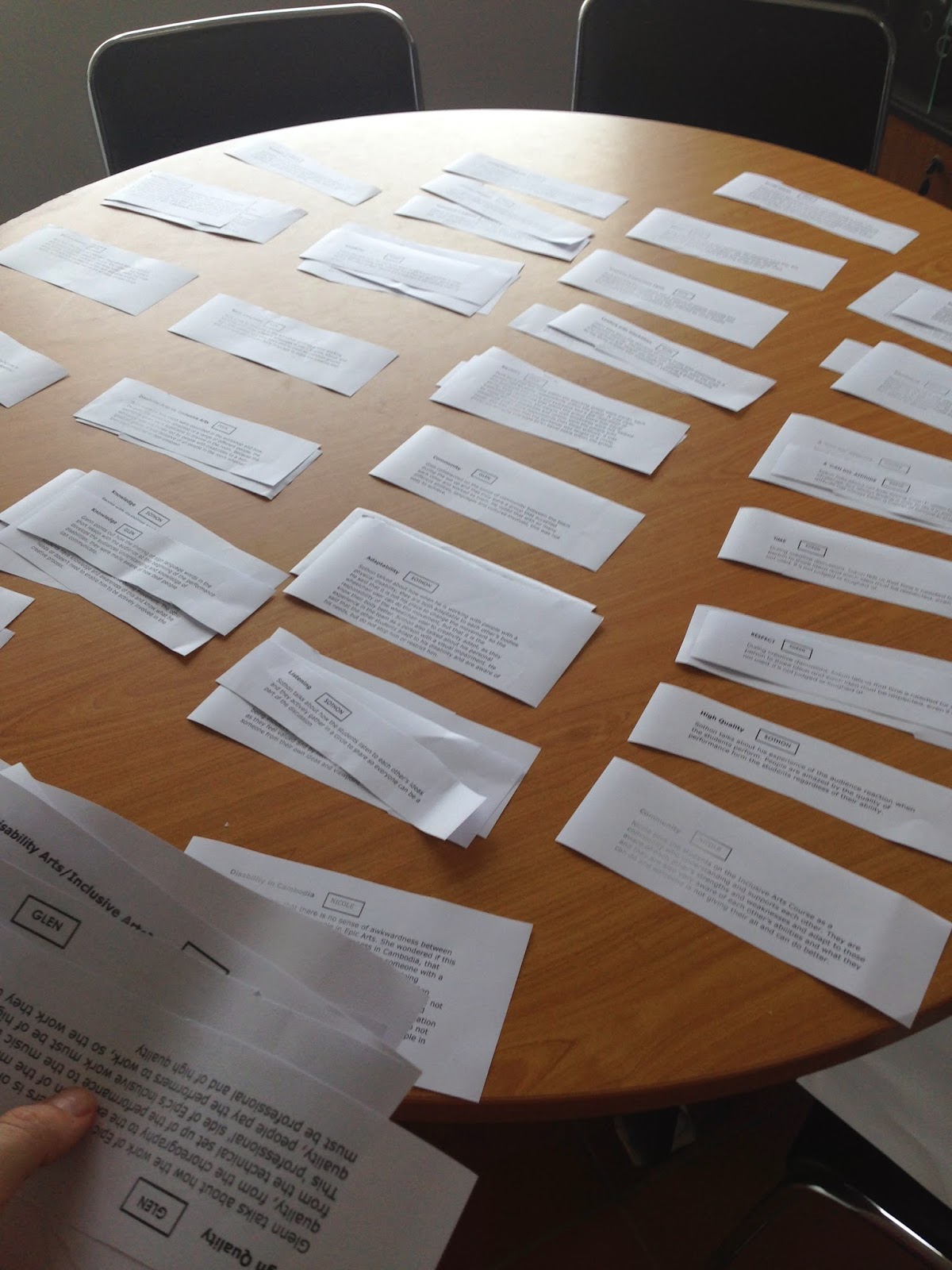
I repeated the process for all of the interviews and observations that I carried out and then printed them all out so I could start to gather them in to groups. I am a visual and and kinaesthetic learner, so I need to see the notes and physically arrange them, so I cut all the notes up and spread them across a table and began to gather them in to theme groups. I made sure I named each note with the subject's name or the name of the group being observed, so that I could trace the evidence back to its origin:


Once all the notes had been complied in to theme groups, I added them to one sheet with the theme name and an image on so it would be easier to keep track of all the notes:


Once I had organised these, I was able to look at grouping the themes in to areas that were similar. As I did this I recorded it on a document on the computer so I was able to move different groups around and think about which themes belonged together and keep a track of the process with different versions of this document. 


Here are the different versions of the theme groups that show how I organised and re-organised the themes and then renamed and regrouped them a number of times.


After this process I was been able to group the individual themes in to sub-groups and then in to 3 main areas - Attitudes, Action and Personal Skills:


I was then able to order my interview and observation notes in the same way, first in to sub-groups and then in to the 3 main areas plus one other folder for other elements :


Finally I was able to create an visual representation for each of the 3 main areas that made up the results of the research - The Attitudes, Actions and Personal Skills that had been identified through the data collection to be at the core of the inclusive arts practices at Epic Arts in Cambodia. Here are visuals:


Interview with Nicole Tomita, Staff Member @ Epic Arts

Today I interviewed Nicole Tomita, a long-term volunteer staff member at Epic Arts. Nicole is originally from California USA and has been involved with Epic for 18 months. She has worked in a number of capacities at the organisation, first as the Art Tutor on the Inclusive Arts Course and then as a Graphic Designer for Epic Arts. During her time at Epic Arts, Nicole also enabled her brother Eric to come to Cambodia for six months and volunteer with us, Eric has Down Syndrome. You can view Eric's blog here about his time with us at Epic Arts.


Nicole is also undertaking some research for Epic Arts in to Special Education in Cambodia and you can view her research blog here.


Nicole Tomita, Staff Member @ Epic Arts
Interview, Thoughts and Comments

Nicole and her brother Eric


How would you describe inclusive arts?

I would describe it as doing something creative that is successful and achievable by all people. I think that most art forms in the 'traditional sense', can exclude people in some way, without meaning to, just by the way it is. For example drawing for someone who has difficulty seeing can exclude them just by its nature. But inclusive arts at Epic means that every person who wants to experience or learn about the arts can come here and can learn about it and succeed, because It is adaptable.

What do you think are the things that you do or think that make successful inclusive arts happen at Epic Arts?

I have a number of different jobs at Epic Arts and each one of them has a different function in aiding the organisation in inclusion. For example, when I am teaching it's important to have the right translators in the lesson with regards to the languages used (sign, English, Khmer). It's important that those who cannot hear can still understand everything I am saying. For the graphic design that I do, I work with the team to ensure that the work I do is inclusive of the languages in use and is a visual representation of something to aid those who cannot read. We are currently exploring the use of adding sign images to design work too. I would like to explore how we could make audio designs, creating audio versions of posters would be exciting to be involved in. Here is some of Nicole’s design work for Epic Arts:


In terms of my teaching on the Inclusive Arts Course, there have been many experiences of successful inclusive arts. Last year when a student who was blind joined the course I did a lot of planning and preparation before the lessons. I would plan the lesson overall for all the students but included adaptations for that particular student, so that he would not only be able to access the lesson, but to do so on the same level as the other students. I really enjoyed this, I had to think in a different way and try out my ideas from the student’s point of view so that I would know that it worked... It was fun to do. Generally the main point when I am teaching art to the Inclusive Arts students is that I am well prepared and aware of the needs of each student and how they can work on the project within the group, not just as individuals.

We did one project where we made frames with canvas stretched over them. The group worked together as a team to create each part of the frames and then added painted images to them. Some students where better at one part of the process than others, sometimes this was due to their disability, sometimes not, but they worked out the best place for themselves within the team and worked as a unit to complete the work. 

What do you think other people need to do or think to make successful inclusive arts happen?

I think when working in an inclusive arts environment you have to reconsidered everything you would normally do and look at what you plan to do from the perspective of each of the students. Sometimes something will come up that you can't prepare for, an unexpected difficultly, but this is a opportunity to enable the student and ask them how can they adapt the activity to suit them. This adaptability is the equal responsibility of both the student and the teacher, but I find that the most important thing is to talk to the person you are adapting for, they know themselves the best and it is important not to assume what someone can and can't do.

I have one student with a visual impairment in the class, but I never assume he can not do something, I often provide a suggested adaptation to an activity, sometimes he tries it, sometimes he says he is happy with the original idea and sometimes he comes up with a better solution than I had and I learn something new. I think it's very important to keep open lines of communication between everyone to enable development, understanding and learning on all sides. When doing an inclusive arts project it's so important not to take an individuals choice and creative decisions away from them, even when this is well meaning and is intended to assist. The one key thing I have learnt is to keep talking, keep listening, keep communicating and keep asking questions and giving suggesting; it's a learning journey together.

In terms of the kind of attitude people need to make successful inclusive arts happened, I would say it is important to have a creative outlook and be a creative thinker and problem solver. It's important to not be too proud and to see the whole process as a personal learning journey rather than a joint learning journey. We must try not to be offended ore take something personally if we are are told something isn't working, but to take a step back and rethink it, don't be too stubborn. The inclusive arts environment needs to be open and changeable and there needs to always to be space within it to move and to learn as we go.

I like to see the inclusive arts students when they are together outside of their workshops; they work together and assist each other when needed without even thinking about it. For example there may be a student who is deaf and a student who is a wheelchair user and they need to get something that is high up and the deaf student will just notice that they can assist, not make a big deal out of it and just reach it for them, there is no communication, just an understanding. Seeing these moments of natural understanding and awareness is wonderful, the students are so natural together and know the needs of each other.

The students are very much a community and they can read each other and often don't need to ask each other if they need help, they know the strengths and weakness of each other. They also know when someone can do something and maybe chooses not to, they also don't let people get away with being 'lazy' or not doing things that they are completely capable of. There isn't a sense of awkwardness between people in general at Epic, if someone can do something themselves they do it, if someone needs assistance they ask, or people just know. I think that because there is no real political correctness in Cambodia compared to the West, there isn't that fear of doing something wrong, there is just a sense of community, understanding and respect.

Have you ever experienced this yourself and can you give me an example?

I think the beauty of the work at Epic is that no one 'tip-toes' around people, there is very much a sense of aiming for high quality and that often means telling people where they are going wrong and how they can do something better. This often means telling people with disabilities that they are not doing something as well as they could, or that they could make improvements here and there. There is a sense of striving for the best, pushing to be the best that we can be regardless of ability and that often means being honest and open with everyone on an equal level.

I think sometimes in the West people are fearful of criticising someone with a disability, thinking that will be seen as being unfair or mean, but all people are people and if we want people to grow and develop they need to be told where they are going wrong and how they can improve regardless of who they are. Again in the West I think we try hard to cater to people with disabilities, which is how it should be, but at times this can lead to people with disabilities getting used to 'special' treatment and other people being fearful of telling them they are wrong. Whether people have or do not have a disability it is equally important that people are told honestly what they are doing in the arts, there is no help in telling someone over and over that something is great when it isn't - there is no learning and no development.

In Cambodia there is a 'get on with it' attitude with many of those with disabilities. There is not much help or assistance and if you want to get out of the house and survive, you have to work out a way to do it. This is not a good thing, but I think it has cultivated this attitude of determination and adaptability and pushing for more. There is an 'I can do it' attitude that many of the people with disabilities at Epic have, which I think has grown from their life experiences as disabled people in Cambodia. It's different from the West in that way, there is help and assistance and adapted buildings and transport and there is financial help from the government and while this is a positive thing, I do wonder if this has produced a reliance and can, for some people, reduce independence and adaptability.

What do you think people do or think that can stop successful inclusive arts from happening?

I think that sometimes people can make assumptions about people with disabilities, they assume someone cannot do something, or they assume that because I am non-disabled I must be the disabled persons 'carer'. This has happened a number of times when I am out in the town in Kampot with my friend who is a wheelchair user. People will talk to me and not him as they assume that he cannot understand or he needs help. This tends to be because people are just not aware; people don't have much knowledge about people with disabilities in Cambodia.

The main reason for inclusive arts being unsuccessful is people’s pre-conceived ideas and assumptions of people's limits. I have a brother who has Down Syndrome and this idea has been something that we have battled with throughout his life, people are always making assumptions of what he can and can't do. There are things that he can't do or doesn't want to do, but he needs to make these decisions himself, not be told what he can't do or isn't capable of. Sometimes my brother just needs a little more time than other people to do things, but this doesn't mean he can't do it. There have been times when people have tried to make choices for him and taken opportunities away because they have thought he couldn't do it, rather than giving him a chance to try.

I have had experiences when people have told me I shouldn't do something with my brother or teach him something because 'it's not really worth it because he has Down Syndrome', so I think for me it's so important to believe that everyone is capable of doing anything if they want to, they just need to do it in their own way. Sometimes maybe a person can genuinely not do something and that's ok, but you have to let that person work that out for themselves, not make the decision for them.

I remember when I first joined Epic and did my first end of term assessment for the Inclusive Arts Course. I read the guidelines for teachers on how to conduct the assessments and I read the part about how students are assessed and that they aren't being assessed on a scale of 'bad to good', but on a scale of their personal best and their personal ability. I felt that even in terms of assessment, the way that the Inclusive arts Course is set out is not making assumptions, but for people to develop and grown within their personal capabilities - each student is a creative individual.


In the past I have seen and experienced people making assumptions about people which limits what people can do or think they can do, also I have experienced people not being adaptable and wanting things on their terms and expecting people to move to meet them, rather than trying to 'meet in the middle'. It's so important that people are aware of other people and their experiences of a situation and how we all need to adapt, move and change to make space for another person. We cannot be selfish and want something to be the way we want it, in the same way, we shouldn't move too close to what the other person needs too; their needs to be a middle ground, their needs to respect ourselves and of each others - This the true nature of inclusion in the arts.
…………………………………………….


What has this told me about the inclusive arts practice within this activity at Epic Arts? What are the key themes?


Adaptability

Nicole talks about how the arts can be excluding purely because of how arts skills are traditionally perceived. She says that inclusive art means that these skills are adapted to enable the arts to be inclusive of all people. Nicole explains that people must also not be focused solely on what they need and then expect everyone to adapt to them, but to allow for people to ‘meet in the middle’ when adapting

Communication

Nicole recognizes the importance of clear and effective communication what she is teaching on the Inclusive Arts Course. If the students cannot understand her then they are excluded so she uses Khmer/English and Khmer/ Sign translators throughout her lessons. In her design work, Nicole is aware of the need to make visual representations in her designs and combines languages and images to enable easy understanding and recognition of a logo or design.

Knowledge

Nicole talks about a time she planned work for a student who was blind who would join an art class. She gained knowledge about his disability and experimented with how she could adapt the activity for him. She tried to improve her knowledge and own understanding by putting her self in his position. She points out that its is key for her when teaching to be knowledgeable about the needs of the students


Teamwork

Nicole tells the story of the Inclusive Arts students working to make canvas frames as a clear example of teamwork. She recognizes that the students learnt what their strengths and weakness were, as a team, and then they created roles within the team to achieve the tasks set by drawing on each person’s strengths. Nicole also explains that its important to have a team based attitude, not to be too proud and to focus on a personal learning journey, but the learning journey of the group as whole

Listen

Nicole explains that when she is adapting an activity for a student its important that she listens to them and allows for them to make their own decisions. She says that in inclusive arts teaching she needs to keep listening, asking questions and giving suggestions. She also talks about ‘listening’ to other people when she says its key for us to be aware of other people’s experience of a situation. We need to look and listen to how someone is experiencing something to prevent any exclusion


See Ability

Nicole emphasized the importance of seeing the ability in her students and not deciding what they can or cannot do, but providing options and adaptations and then enabling the students to make their own choices. Often she finds that the students themselves have an idea of how they could adapt an activity that is better than her own adaption. Nicole shares a personal story about her brother who has Downs Syndrome and how she gets frustrated when people deicide what he can and cannot do before he is allowed to try. She says sometimes he does not want to do something or cannot do something, but she wants him to have that the chance to make that decision himself.


Creative Interaction Cycle

Nicole calls teaching on the Inclusive Arts Course a learning journey that is taken together. She gives examples of how she learns from her student and they learn from her, they each make an impact on each other’s development.

Individual Creativity

Nicole states that she feels that to be successful within inclusive arts, practice people need to be creative in their outlook and have the ability to be a creative problem solver and creative thinker. This does not necessarily mean someone needs to be skilled in an arts area, but to be individually creative in his or her own area of work. Nicole also discusses the assessment criteria of the Inclusive Arts Course and says she likes the way that the assessment enables each person to develop creatively within their ability in order to achieve success

We Are Human

Nicole points out that the natural human response of being offended if we are told something is wrong, as something that can hinder inclusive arts practice. She believes that we must all try to move away from this natural human response, not to be too proud or stubborn, but to learn when something doesn’t work and be able to rethink and change an idea.


Inclusive Ambassadors

Nicole notices that the idea of inclusion and acceptance is not just resigned to the arts workshops at Epic Arts, but is a part of everyday life for the staff and students. They are aware of the needs of each other and they respond to these needs.

Community

Nicole sees the students on the Inclusive Arts Course as a community who understanding and supports each other. They are aware of each other’s strengths and weaknesses and adapt to these and they are also very aware of each other’s abilities and what they can do and someone is not giving their all and can do better.

Disability in Cambodia

Nicole recognizes that there is no sense of awkwardness between disabled and non-disabled people in Epic Arts. She wondered if this is to do with the state of disability awareness in Cambodia, that there is no assumed ‘right or wrong’ way to treat someone with a disability, so there is no fear of offending or saying or doing something wrong. Nicole says that in the West people are often fearful of criticizing someone with a disability, but she feels that not being told what is right and wrong causes problems socially and developmentally. She feels that in the West, with the determination to cater to the needs of people with disabilities, we can end up not giving equal treatment, but ‘special’ treatment. She feels people in Cambodia are more open to being honest with people with disabilities.


High Quality

Nicole says that at Epic Arts everyone is striving for high quality in the work they do and this sometimes means saying when something can be improved or when something is not good enough, but there is no fear in saying that to anyone, regardless of status or ability, if it is genuine and honest.


A ‘Can Do’ Attitude

Nicole says that, in Cambodia, she sees that for many people with disabilities they have a ‘Can Do’ attitude that has grown out of necessity. Because there are few provisions for people with disabilities in Cambodia, many people with disabilities have to work out a way of doing something themselves if they want tot do it. Nicole wondered if the services provided for people with disabilities in the West, though totally necessary, have led to a reliance on services and that this has removed the need for a ‘Can Do’ attitude for some people in the West.


Respect

Nicole explains that she thinks that respect is a key attitude in inclusive arts practice. She says we need to respect others and also ourselves and not compromise too much when making adaptations and move to far in one direction, but try to meet on a middle ground.